
Darlington Transistors: High-Gain BJT Pairs, Performance, and Practical Types
Darlington Transistors: Comprehensive Analysis and Applications
Formation and Physical Essence of the Darlington Structure
The Darlington transistor dates back to the 1950s when engineer Sidney Darlington proposed combining two bipolar junction transistors (BJTs) to achieve higher current gain. At that time, the current gain of a single BJT was limited—typically in the range of tens to a few hundred. If higher gain was required, designers had to use multi-stage amplifiers, which increased complexity and PCB space usage.
Darlington’s idea was straightforward: connect two transistors in such a way that the amplified current of the first transistor directly drives the second one. The result is a device that functions like a single transistor but with an extraordinarily high gain.
Structurally, two BJTs of the same polarity (either NPN or PNP) are connected: the emitter of the first drives the base of the second, and their collectors are tied together as a common output. The effective current gain is approximately:
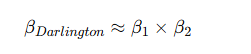
For example, if two transistors have gains of 100 and 200, the combined gain may reach 20,000—an amplification level nearly impossible for a single transistor.
This explains why Darlington transistors are often categorized within the types of transistors that emphasize extremely high current amplification and ease of control in low-power-to-high-power interface designs.
Characteristics and Limitations
The Darlington structure, while simple, introduces both advantages and constraints.
1. Higher Saturation Voltage
A single BJT requires about 0.7V base-emitter voltage to conduct. In a Darlington pair, two junctions are involved, so the saturation voltage is typically 1.2V–1.4V or higher. This makes them less efficient in low-voltage systems such as 3.3V logic circuits.
2. Switching Speed Limitations
Because two transistors are involved, carrier storage increases, and both turn-on and turn-off times are longer than those of a single BJT. Darlington devices are significantly slower than MOSFETs, limiting their use in high-speed switching applications.
3. Thermal Behavior
Darlington devices dissipate more power due to higher voltage drop, generating additional heat. Without proper heat management, thermal runaway may occur. To mitigate this, some packages integrate resistors for current balancing or require heat sinks.
4. High Input Impedance
On the positive side, Darlington transistors exhibit very high input impedance, meaning that only a tiny base current is required to control a large collector current. This property makes them attractive in interfacing weak signals with heavy loads.
Classic Models and Practical Applications
1. Widely Used Darlington Transistor Models
TIP120 / TIP121 / TIP122
Produced by STMicroelectronics, these NPN Darlingtons support voltages from 60V to 100V and currents up to 5A. They are widely used for DC motor drives, lamp dimming, and audio amplification.
TIP125 / TIP126 / TIP127
Complementary PNP counterparts of the TIP12x series, often paired with NPN versions for push-pull amplifier designs.
MJ11015 / MJ11016
High-power Darlingtons from ON Semiconductor, capable of handling over 30A, commonly employed in industrial motor control, welding machines, and regulated power supplies.
ULN2003 / ULN2803
These are Darlington arrays, integrating 7 or 8 Darlington pairs with built-in diodes for inductive load protection. They are industry standards for stepper motor drivers, relay boards, and LED arrays.
2. Common Engineering Applications
DC motor control: With TIP122, a microcontroller GPIO can directly drive a motor requiring several amps.
Relay driving: ULN2003 modules are standard add-ons in Arduino and STM32 kits.
Audio power amplifiers: TIP122+TIP127 pairs form cost-effective push-pull stages.
Voltage regulation: Used as current-boosting stages in linear regulators.
Comparison with Single BJTs
When comparing a Darlington transistor with a single BJT:
Current Gain: A single transistor has limited gain, while Darlingtons multiply the gains of two devices, reaching thousands or more.
Voltage Drop: Single BJTs have a low saturation voltage (0.2–0.3V), while Darlingtons are typically 1.2–2V.
Application Scenarios: Single BJTs are preferred for high-speed switching or small-signal amplification. Darlingtons excel in driving large currents with minimal control effort.
For example, driving a solenoid with a single transistor may require an additional amplifier stage, whereas a Darlington can be triggered directly from a logic output.
Comparison with MOSFETs
The rise of MOSFETs in the 21st century has shifted many applications away from Darlington devices. Still, both types of transistors have distinct roles.
Conduction Characteristics
MOSFETs feature extremely low on-resistance, minimizing power loss.
Darlingtons inherently suffer from higher voltage drops.
Switching Speed
MOSFETs, being voltage-controlled devices, switch much faster, making them ideal for high-frequency designs.
Darlingtons are too slow for such tasks due to charge storage effects.
Cost and Ease of Use
Darlingtons are inexpensive and require no complex drive circuitry.
MOSFETs, though more efficient, may need dedicated driver ICs in certain conditions.
Historical Perspective
In the 1980s and 1990s, the TIP120 series was often called the “universal power transistor.” Today, MOSFETs dominate high-efficiency designs, but Darlingtons still survive in educational kits and cost-sensitive designs.
The Unique Position of Darlington Transistor Arrays
While discrete Darlington transistors are less common today, Darlington arrays remain widely adopted.
Advantages include:
High Integration: Multiple channels in one IC save PCB space.
Built-in Protection: Integrated diodes safeguard against inductive back-EMF.
Logic Compatibility: TTL and CMOS logic can directly drive the array.
Long-term Reliability: ULN2003/2803 have been industry standards for decades.
A common example is the use of ULN2003 in stepper motor driver boards, where a microcontroller outputs logic signals to control coil currents—simple, reliable, and cost-efficient.
Future Applications and Trends
Although largely replaced in mainstream high-efficiency circuits, Darlington transistors continue to find relevance:
Education and Training
Devices like TIP122 and ULN2003 are still essential in electronics labs, demonstrating amplification and switching principles.
Low-Cost Control Circuits
For applications where efficiency is less critical, Darlingtons remain attractive due to simplicity and low cost.
Industrial Maintenance
Many legacy systems still rely on Darlington-based designs, ensuring ongoing demand in replacement markets.
Enduring Arrays
Darlington arrays, thanks to their integration and robustness, are likely to remain in embedded control systems for the foreseeable future.
The history of Darlington transistors reflects the evolution of types of transistors in electronics. Once hailed as universal high-gain power devices, they have since been surpassed by MOSFETs in efficiency and speed. Yet, they continue to thrive in niches such as educational tools, low-cost motor drivers, and integrated arrays like ULN2003.
For engineers, understanding Darlington transistors is not merely about learning one device—it provides insight into how semiconductor technology advances while retaining older solutions for specialized needs.